

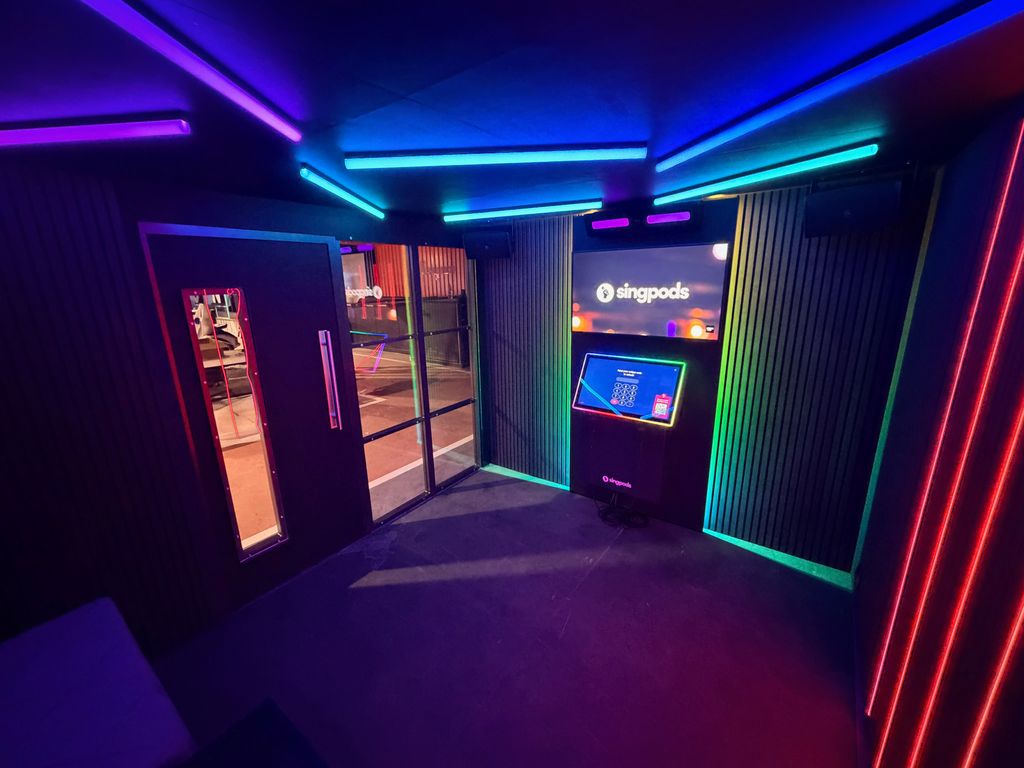
Capturing quality video content at live events can be difficult. Exhibition halls, stadium environments, and busy activation spaces bring background noise, changing conditions, and a constant flow of people, all of which can make consistent recording challenging.
A SingPod provides another option. Its acoustically treated environment can be adapted into a compact video studio, creating a dedicated space where brands can capture content directly from event attendees. Rather than using the Pod for karaoke, the same enclosed format can support professional AV capture and processing. With 4K cameras, broadcast microphones, and integrated software, the space becomes a controlled environment for creating structured video content.
Recent projects for Welsh Rugby and iFit demonstrate two very different applications. Welsh Rugby used the format as a Reaction Cam powered by PixPods.ai, while iFit transformed the space into an Audition Cam where participants responded to on screen prompts and direction. Both examples show how the same physical format can be adapted around the content a brand wants its audience to create.
The controlled environment is particularly useful at busy events. Instead of trying to record interviews or reactions in an open space surrounded by crowds, music, and other activity, professional video booths provide a dedicated location for participants to step inside and record.
Acoustic treatment helps reduce interference from the surrounding environment, while integrated cameras and microphones provide the equipment needed to capture both video and audio within the same space. The result is a compact production environment designed around participation rather than a conventional camera crew and temporary filming area.
Turning a SingPod into a video studio starts with bringing the core production equipment together within the existing structure. 4K cameras provide the visual capture, while broadcast microphones handle audio. Because the recording environment is fixed, the equipment can be positioned around the space rather than repeatedly adjusted for each participant. This creates consistency between recordings. Participants enter the same environment, stand or sit within the same defined area, and interact with the same camera and audio setup.
The acoustically treated interior is equally important. Live events are rarely quiet, and open recording areas can easily pick up conversations, music, announcements, and other background activity. Moving the recording into an enclosed Pod creates greater separation between the participant and the surrounding venue.
Lighting can also be integrated into the setup so the recording environment remains consistent as different people move through the activation. Instead of rebuilding the production setup for each participant, the Pod remains ready for the next recording.
Professional AV capture and processing then brings these elements together. Camera footage and microphone audio can be handled within the same system, creating a repeatable workflow for capturing content throughout the event. For organisers, this means the production environment does not need to be recreated every time someone steps in front of the camera. Once configured, the Pod provides a dedicated recording space that can support repeated sessions throughout the activation.
The value of the format becomes clearer when the same underlying setup is used for very different creative concepts. For Welsh Rugby, the Pod became a Reaction Cam using PixPods.ai. Supporters could step inside and capture their reactions and comments within a dedicated environment.
This changes the dynamic compared with a conventional interview conducted in an open public area. Participants have their own space to respond to what they have just experienced, while the camera and audio setup captures the moment.
For a sports activation, those reactions can provide particularly valuable content because the format is built around immediate emotion. Supporters can respond while the excitement of the event is still fresh rather than being asked to recreate the moment later.
iFit approached the same technology from a different direction. Its Audition Cam used on screen prompts and video direction to guide participants through the recording. Instead of relying on an interviewer to provide instructions for every session, the experience gave users a structured process to follow inside the Pod.
That made it possible to create a more consistent format across multiple submissions. Participants received the same guidance and interacted with the same recording environment, helping create greater consistency across the resulting footage.
These examples demonstrate the flexibility of event content production within a SingPod. One activation can focus on spontaneous audience reactions, while another can guide participants through a defined audition or submission process. The technology remains largely behind the scenes. What changes is the experience presented to the participant and the type of content the brand wants to capture.
Space is often at a premium during events. Exhibitors and activation teams need to balance event content production and audience engagement with practical requirements such as equipment, staffing, visitor movement, and production areas.
Using a SingPod as a video studio brings the recording environment into a defined footprint. Cameras, microphones, lighting, and supporting technology can be incorporated into the Pod rather than spread across a larger temporary production area. That can make the activation easier to position within an event while giving participants a clear destination for recording their content.
The enclosed format also separates the recording process from surrounding activity. Someone can step inside, follow the experience, record their content, and leave the space ready for the next participant. This supports a repeatable workflow where multiple people can take part throughout the event without requiring the production environment to be reset each time.
For brands, that repeatability is important. Live activations may generate dozens or potentially hundreds of individual interactions, and the value of the resulting content depends partly on how consistently those moments can be captured.
The Welsh Rugby and iFit projects demonstrate how a SingPod can move beyond its original karaoke format and become a flexible content capture environment. One became a Reaction Cam built around spontaneous supporter responses. The other became an Audition Cam designed around structured prompts and participant submissions. Both used the enclosed Pod format to create dedicated professional video booths within a wider event.
For brands exploring new ways to involve attendees in their content, this creates an opportunity to make recording part of the activation itself. Participants are not simply watching branded content. They are stepping inside the experience and helping create it.
A SingPod can therefore serve two very different purposes depending on the campaign. It can be a private karaoke environment built around group entertainment, or it can be adapted into a compact video studio built around professional content capture. Add instant karaoke in any space! Contact us now for more information.
